Overview
EduSuite is a SaaS platform where many institutes and colleges each run their own separate space on one system, on a subscription plan. It covers the full student lifecycle (admission, attendance, fees, exams, results, certificates) plus an LMS, live classes and a marketplace that sells institutes' courses online.
Product context
Built and operated as Naya Prayog's own product. Naya Prayog Academy runs on it as one of its institutes, and its course store powers the Academy's online sales.
Problem
Institutes typically run admissions, fees, attendance and results on paper registers or several disconnected tools. Parents call the office for every update, certificates can't be verified by employers, and selling courses online means stitching together a website, a payment gateway and a video host.
Objectives
- One system for academics, fees, staff and reporting, isolated per institute
- Self-service portals for students, teachers and parents
- Online course sales with instant enrolment after payment
- Exams and certificates that can be trusted and verified publicly
My role
Product owner & lead engineer: product design, architecture, full-stack development and deployment.
Engineering approach
A single React SPA serves every role, from students, teachers and parents to institute admins and the platform super admin, against one Express API. Every request is checked for both role and institute, so a tenant can only ever see its own data. Real-time pieces (seat counts, payment confirmations, live-class status) go over Socket.IO instead of polling.
Technical architecture
- React + Vite + Tailwind SPA
- Student, teacher, parent & admin portals
- Public verify pages
- Node.js / Express
- JWT auth
- Role + institute scoping on every request
- Socket.IO
- PostgreSQL via Sequelize
- Collision-safe document numbering
- Razorpay + signed webhooks
- Private S3 (signed links)
- Cloudinary images
- Self-hosted Jitsi
- SMTP email
- Linux VPS
- Apache reverse proxy + TLS
- PM2
Frontend
Mobile-first React app with light and dark themes and three interface languages (English, Hindi, Spanish). It includes an in-app document reader that turns uploaded PDF and Word files into a section-by-section view, and a protected video player that keeps YouTube and Vimeo lessons inside the platform.
Backend
Express API with JWT authentication and role- and institute-based authorisation on every route. It handles exam eligibility re-checked on the server, auto-save and timed submission, automatic grading of objective questions, and a scheduled job that finalises abandoned exam attempts every five minutes.
Database design
PostgreSQL through Sequelize models for institutes, users, courses → batches → modules → lessons → resources, enrolments, attendance, fees, exams, results and certificates. Certificates, marksheets, ID cards and roll numbers use collision-safe numbering.
Integrations
- Razorpay for course sales, fees and subscriptions, with signed webhooks
- AWS S3 for private documents, videos and exam photos, via short-lived signed links
- Cloudinary for image resizing and optimisation
- Self-hosted Jitsi for embedded live classes
- SMTP for welcome and password-reset email
AI capabilities
Exam identity verification: the student's webcam photo is matched against their profile photo before the exam, and periodic face checks during it record 'face not detected', 'face mismatch' and 'tab hidden' events with photos for review.
Infrastructure & deployment
Runs on a Linux VPS behind Apache with Let's Encrypt TLS. The API runs under PM2; the frontend is a static Vite build served from the web root alongside the other Naya Prayog apps.
Challenges & solutions
Tenant isolation
ChallengeMany institutes share one database, and one leaked query would expose another institute's students.
SolutionAuthorisation middleware scopes every request by role and institute; one person can belong to several institutes and switch between them explicitly.
Payments that never double-charge
ChallengeWebhooks and browser callbacks can both report the same payment, or arrive twice.
SolutionPayments are processed exactly once via signed webhooks; duplicate purchases are refunded automatically or flagged for manual refund.
Exam integrity
ChallengeChanging an answer key after students have attempted an exam would silently corrupt scores.
SolutionQuestion marks and answer keys lock once an exam has attempts, eligibility is re-checked server-side, and abandoned attempts are finalised by a scheduled job.
Protecting paid content
ChallengeCourse videos and documents must not be shareable outside the platform.
SolutionFiles live in a private S3 bucket and open only via short-lived signed links; videos play in a locked-down embedded player.
Trustworthy certificates
ChallengeEmployers need to verify a certificate without logging in.
SolutionUnique numbering with QR codes and public verification pages for certificates, marksheets and roll numbers.
Features
- Admissions, students, teachers, staff and parent portal
- Attendance, fees with online payment, results and marksheets
- Certificates and ID cards with QR verification
- LMS: courses, batches, modules, lessons, assignments
- Live classes with recordings attached to the course
- Online exams: builder, proctoring, auto-grading
- Course store with cart, GST and instant enrolment
- Blog, careers with applications, webinars, community board
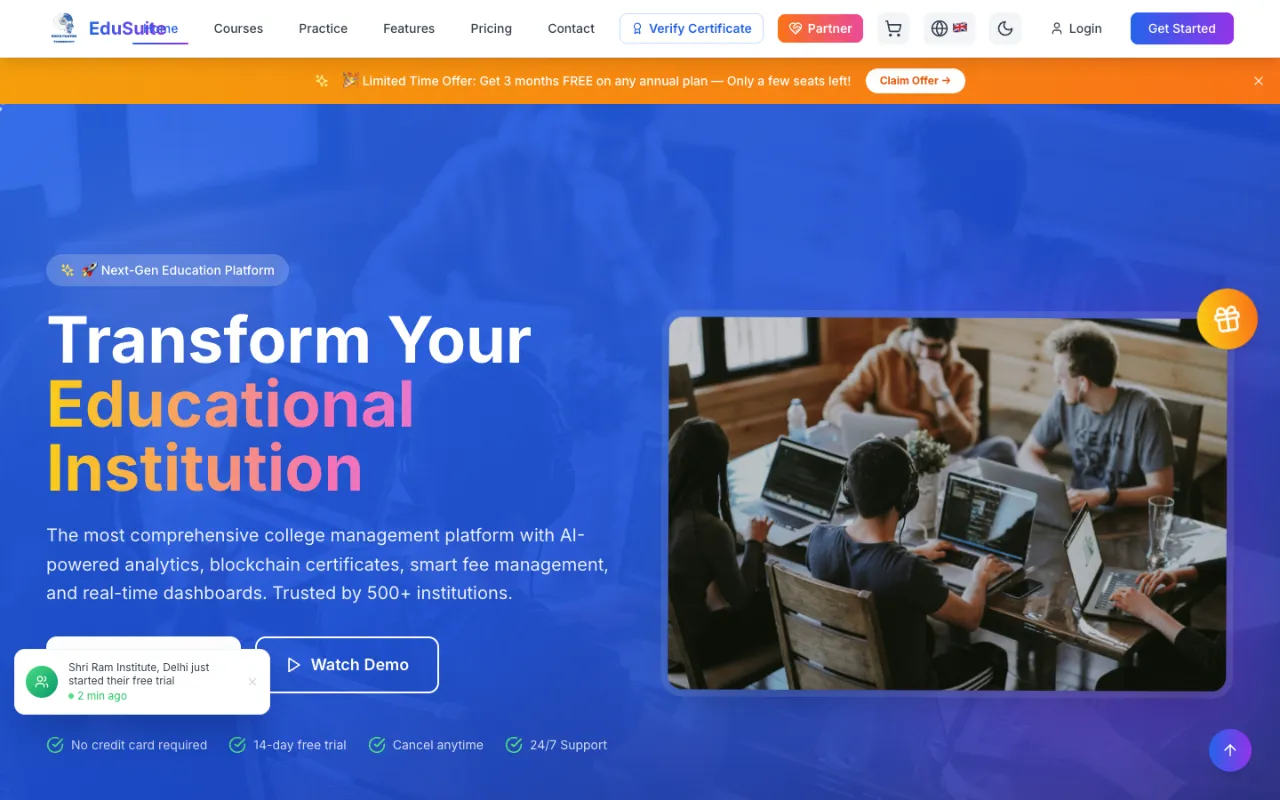
Screenshots
Lessons learned
- Put tenant scoping in middleware, not in individual queries, so it can't be forgotten.
- Treat payment webhooks as the source of truth and design every handler to be idempotent.
- Freeze data that downstream results depend on, rather than trying to recompute after edits.